Contact Chelmsford Roofing Experts

Tell us what is happening with your roof or what you are planning to build. Share the property's location, the area involved and any useful photographs or reports. Chelmsford Roofing Experts can then discuss the appropriate assessment, the information needed and the next step towards a clearly defined roofing quotation.
Get in touch

Need Roofing Help? Reach Out Today

Property Enquiries

Chelmsford, Essex. Include your postcode to confirm availability.

Send an Enquiry

Use the contact form to describe your property and roofing requirement.

Telephone Enquiries

+44 7584 760107

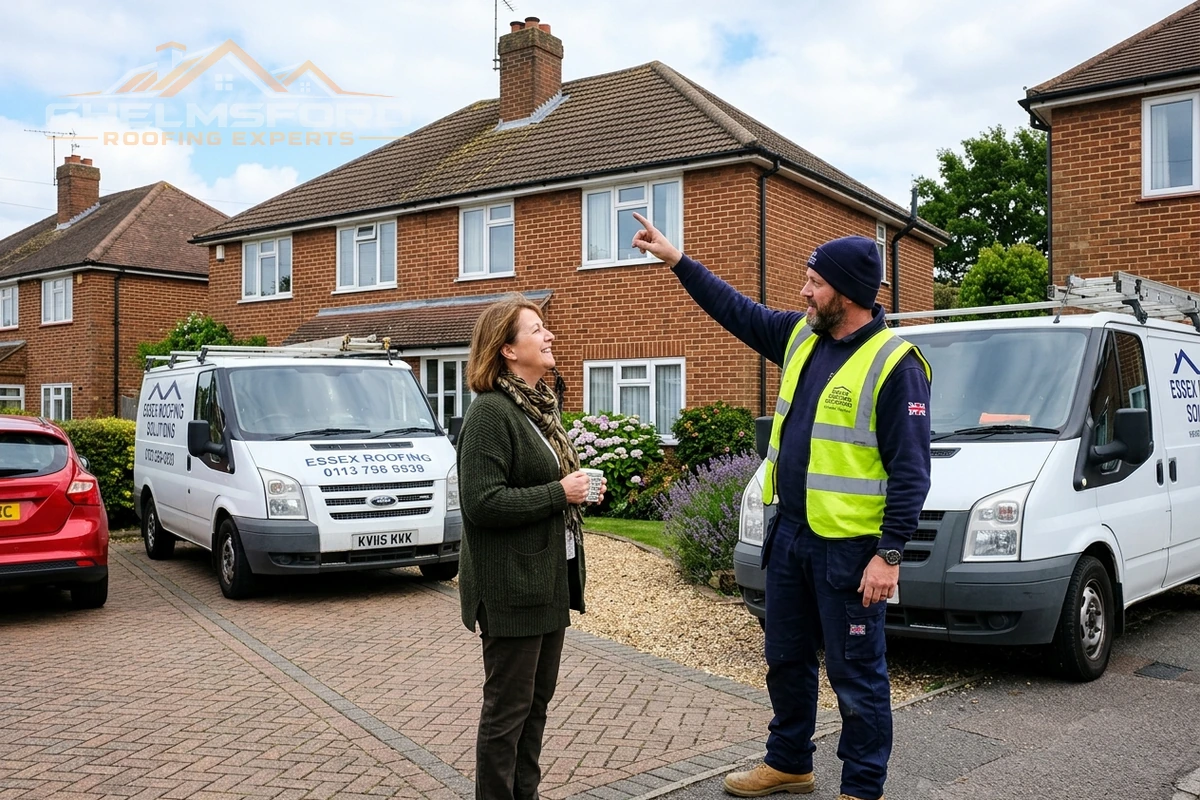
Chelmsford Roofing Experts estimator discussing roof inspection with homeowner in Essex
Send us a message

Book a Free Roof Inspection

Common Questions

Frequently Ask Questions

You Do Not Need to Diagnose the Roof Before Enquiring

You Do Not Need to Diagnose the Roof Before Enquiring

Describe the concern in your own words. A stain near a bedroom window, an overflowing gutter or damage visible after strong winds is enough to start a conversation. Say which part of the building is affected and what you have noticed over time. You do not need to identify a flashing, membrane or roof component before asking for an assessment.
For planned work, explain the objective: an extension, a new roof, renewal of an existing covering or a better understanding of condition. Drawings and previous reports can help establish the context. Make clear whether you are the owner, an appointed representative, a buyer or a person managing the premises, so any permissions needed for access can be discussed.

What to Include in Your Roofing Enquiry

The most useful first message combines the location, the symptom or project and the practical arrangements for an assessment. Include what you know without guessing at concealed causes. If the concern changes with rainfall, wind direction or use of a room, explain that pattern as an observation rather than a confirmed diagnosis.
Photographs should come from a safe position at ground level. A wider image helps identify the building and roof area, while an existing photograph of a stain or visible defect can illustrate the concern. Do not climb a ladder or walk on the roof to obtain a closer view.

From Initial Details to an On-Site Assessment

Chelmsford Roofing Experts offers free roof inspections. At booking, agree the inspection scope, access and availability, including which roof areas can be assessed. Opening up, scaffolding, written reports and condition or homebuyer surveys are not automatically included in that offer; agree any separate service and charge before it is arranged. Identify restricted access or multiple roof areas when enquiring.
Photographs assist initial enquiries, but accurate diagnosis and a fixed quotation require an on-site inspection of the relevant roof details. The assessment should consider the reported symptom alongside the covering, adjoining junctions and rainwater route. If parts of the roof are concealed or inaccessible, those limits should be explained along with any proposed further investigation.
For a condition or homebuyer roof survey, confirm the inspection purpose and reporting requirements separately. A roofing survey is not a full RICS structural building survey. A report may identify the need for another specialist where a question falls outside its agreed scope.

What the Quotation Discussion Should Cover

A quotation should describe the work area, recommended materials, preparation and relevant adjoining details. Access, protection and waste removal also need to be clear. Ask which findings the proposed work addresses, what remains excluded and how any concealed deterioration would be handled if it becomes visible during the project.
For new construction or substantial alteration, identify the drawings and professionals involved and clarify who will check applicable approvals. Chelmsford Roofing Experts has public liability insurance; ask for current details relevant to the work. Written workmanship guarantees are provided, with scope and terms confirmed in the quotation. Review these alongside the programme, exclusions and process for agreeing any additional work.

If the Roofing Concern Is Urgent

State clearly if water is entering now, the roof has changed after severe weather or loose material may affect an area people use. Give the location and explain any immediate access concern. Ask about current availability and the practical next step; an enquiry does not establish a guaranteed arrival time.
Keep people away from loose materials and affected roof areas, and do not attempt to climb onto the roof. Safe temporary weatherproofing and a permanent repair may require separate visits or scopes. The appropriate response depends on the condition found, weather and safe access at the property.

Make Your Enquiry Ready for the Next Step

#01 A Useful First Conversation

Clear observations help establish what needs to be investigated. Dates, locations and changes in the symptom can be more useful than a guessed technical label. Sharing those details lets the assessment begin with a defined concern, while leaving room for the on-site findings to establish the cause and appropriate work.

#02 Inspection Before Commitment

Seeing the relevant roof details allows the recommendation to reflect the property. It also establishes what cannot yet be confirmed. Discussing those limits before agreeing to work helps distinguish a fixed scope from an unresolved investigation and gives you a clearer understanding of the information supporting the quotation and any further assessment proposed.

#03 Confirm the Booking Arrangements

The outcome of an enquiry should be practical: information to provide, an assessment to arrange or a scope to consider. Confirming access, permissions and responsibilities makes that next step clear. Once findings are available, a written recommendation lets you review the work and ask questions before deciding how you wish to proceed.
Can I make an enquiry without roof photographs?
Yes. Provide the postcode, property type and a clear description of the concern or project. Existing reports or drawings may help, but you should not take risks to obtain images. Photographs assist preparation when available; they are not a substitute for inspecting the relevant roof details on site before an accurate diagnosis and fixed quotation.
Share the relevant roof-related extract, the property details and the question you need answered. Explain whether you own the property or are buying it and who can authorise access. Confirm the requested inspection and reporting scope, especially where the surveyor is asking for further investigation rather than a straightforward repair quotation.
You can discuss the requirement, but access and inspection permissions need to be established with the owner or authorised representative. Explain your role and provide the relevant contact or access arrangements through the agreed enquiry process. Any opening up or intrusive investigation needs an explicitly agreed scope and appropriate permission before it is undertaken.
Explain the stage of the project and share available drawings showing the roof and its connection to the existing building. Identify the designer, builder or other professional involved where relevant. Say what you need priced or assessed, and distinguish the proposed construction from any existing roof defect that also needs attention.
Ask for the findings and their effect on the original objective to be explained. A recommendation may need a wider scope or further investigation, but that should be discussed before you commit. The written quotation should identify inclusions, exclusions and the process for agreeing additional work if concealed defects become apparent later.